One of the Most Overlooked Keys to School Success
One of the Most Overlooked Keys to School Success
As parents, we often focus on grades, homework, test scores, reading levels, and behavior reports when we think about helping our children succeed in school. While all of those things matter, there is another skill that quietly impacts almost every part of a child's school experience:
The ability to successfully follow routines and move through transitions.
For many children, especially those who struggle with attention, organization, confidence, behavior, or academic performance, routines and transitions can make the difference between a stressful school day and a successful one.
As we approach a new school year, this is the perfect time to help children strengthen these skills so they can return to school feeling more confident, independent, and prepared.
What Are School Routines and Transitions?
A routine is a series of actions that happen regularly and in a predictable way.
Examples include:
Hanging up a backpack upon arrival
Taking out homework folders
Getting materials ready for class
Following morning work procedures
Completing assignments
Cleaning up after activities
Packing up at the end of the day
A transition occurs when students move from one activity, location, or responsibility to another.
Examples include:
Moving from recess back to the classroom
Transitioning from math to reading
Going from lunch to afternoon instruction
Stopping a preferred activity to begin a challenging task
Moving from school time to homework time at home
Adults often take these actions for granted because they become automatic over time. For children, however, these moments require self-control, organization, attention, and flexibility.
When these skills are not yet developed, school can feel overwhelming.
Why Transitions Matter More Than Most Parents Realize
Many school difficulties do not begin with academic ability.
Often, they begin before the lesson even starts.
A child may be fully capable of learning the material, but if they are:
Not prepared when instruction begins
Distracted during directions
Struggling to move from one activity to another
Constantly searching for materials
Having difficulty settling down after recess
Missing important instructions
then learning becomes much harder.
Teachers frequently spend valuable instructional time helping students get organized, settle into activities, and prepare for learning. When students can navigate these moments independently, more time becomes available for teaching, engagement, and academic growth.
This is not about blaming children, parents, or teachers.
It is simply recognizing that success in school requires many skills beyond reading and math.
Independence Starts With Small Daily Habits
One of the greatest gifts we can give our children is the ability to take initiative.
Initiative looks like:
Getting materials ready before being asked
Beginning assignments promptly
Following directions the first time
Recognizing what comes next in a routine
Preparing for transitions before reminders are needed
These habits do not develop overnight.
They develop through practice.
Children learn independence when adults gradually teach, model, support, and then allow them to take increasing responsibility for their own actions.
Many successful students are not necessarily the smartest students in the room.
They are often the students who know what to do, when to do it, and how to stay engaged long enough to complete the task.
Understanding Your Child's School Day
One of the most valuable things parents can do is learn what their child's day actually looks like.
Instead of asking:
"How was school?"
Try asking more specific questions:
What happens when you first enter the classroom?
What do you do after attendance?
What happens during reading time?
How do you transition to lunch?
What happens when lunch is over?
What is the hardest part of your day?
Which class feels easiest?
Which class feels most challenging?
These questions help children become more aware of their own routines.
They also provide parents with important information about where support may be needed.
When children explain their daily experiences, they begin reflecting on their own habits, challenges, and successes.
That reflection is powerful.
Partnering With Teachers
Teachers see children in a learning environment that parents rarely observe firsthand.
Because of this, teachers can offer valuable insight.
Consider asking questions such as:
How does my child handle transitions?
Are they prepared when lessons begin?
Do they follow classroom routines independently?
Are there certain times of day that seem difficult?
What strengths do you notice?
What areas could use more support?
Approaching these conversations as a partnership creates opportunities for growth.
Most teachers appreciate when parents want to understand how their child functions throughout the school day rather than only discussing grades or disciplinary concerns.
Together, parents and teachers can identify patterns and create consistent expectations between home and school.
Identifying Problem Areas Without Judgment
Every child has strengths.
Every child also has areas that need development.
The goal is not perfection.
The goal is progress.
When looking at routines and transitions, identify specific situations that consistently create difficulty.
Examples may include:
Returning from recess
Starting homework
Following multi-step directions
Cleaning up after activities
Staying focused during independent work
Organizing materials
Completing tasks before moving to preferred activities
Once you identify one area, resist the temptation to fix everything at once.
Choose one challenge.
Focus on one skill.
Practice consistently.
Then move to the next.
Growth happens much faster when children experience success in small steps.
The Power of Role-Playing
Children learn best through experience.
One highly effective strategy is role-playing.
Role-playing allows children to practice difficult situations before they encounter them in real life.
For example:
If returning from recess is difficult:
Act it out.
Pretend your child has just finished playing.
Practice:
Hearing the signal to stop
Cleaning up quickly
Walking calmly
Entering the classroom
Getting ready for the next lesson
Pause during the role-play and ask:
What choice would help you be successful here?
What could happen if you make a different choice?
What would your teacher need from you in this moment?
These discussions help children develop self-awareness and problem-solving skills.
Teaching Problem-Solving Instead of Constantly Solving Problems
As parents, it is natural to want to help.
Sometimes, however, helping too quickly prevents children from developing their own solutions.
Instead of immediately providing answers, try asking:
What do you think would work?
What could you do differently next time?
What would help you remember?
What is another option?
These questions encourage critical thinking.
Over time, children begin relying less on adults for every solution and more on their own developing judgment.
This confidence carries into school, friendships, extracurricular activities, and eventually adulthood.
Building Strong Routines at Home
School success begins long before children walk into a classroom.
Home routines provide daily opportunities to practice organization, responsibility, and self-discipline.
Important routines include:
Morning Routine
Children can learn to:
Wake up on time
Get dressed
Brush teeth
Gather materials
Prepare for the day
Homework Routine
Children can learn to:
Organize materials
Begin work independently
Stay focused
Complete assignments
Put materials away afterward
Chore Routine
Children can learn to:
Clean their room
Put away belongings
Help with household responsibilities
Follow through on expectations
Bedtime Routine
Children can learn to:
Wind down appropriately
Prepare for the next day
Establish healthy sleep habits
The goal is not simply compliance.
The goal is mastery.
We want children to know what needs to be done and eventually complete those tasks without constant reminders.
The Connection Between Devices and Transitions
Technology can be a wonderful tool.
However, many parents notice that transitions become harder when devices dominate a child's day.
If a child struggles every time they must:
Turn off a game
Put away a tablet
Stop watching videos
Leave a device for homework, chores, meals, or bedtime
it may be worth evaluating how technology fits into the family routine.
Creating predictable limits around screen time can help children strengthen:
Self-control
Attention span
Patience
Flexibility
Focus
These are all skills that directly support classroom success.
The goal is balance, not elimination.
Children benefit when technology is one part of their day rather than the center of it.
Confidence Grows Through Competence
One of the most rewarding experiences for a child is realizing:
"I can do this on my own."
Confidence does not come from constant praise alone.
Confidence grows when children successfully complete meaningful tasks.
When children:
Follow routines independently
Solve problems
Complete assignments
Stay organized
Meet expectations
they begin to see themselves as capable.
And capable children become confident learners.
Small Changes Create Big Results
Parents do not need to overhaul everything overnight.
Start with one conversation.
One routine.
One transition.
One area for growth.
Observe.
Practice.
Encourage.
Repeat.
Over time, those small improvements begin to stack together.
Children become more organized.
More independent.
More focused.
More confident.
And most importantly, they begin developing habits that will support them far beyond this school year.
Final Encouragement for Parents
If your child struggled this year, remember this:
Growth is possible.
Children are not defined by last year's grades, behavior reports, or challenges.
Every new school year offers a fresh opportunity to build stronger habits, stronger skills, and stronger confidence.
By helping your child master routines, transitions, self-discipline, and independence, you are giving them tools that will benefit them in every classroom, every grade level, and eventually every stage of life.
One routine at a time.
One skill at a time.
One success at a time.
That's how meaningful growth happens.
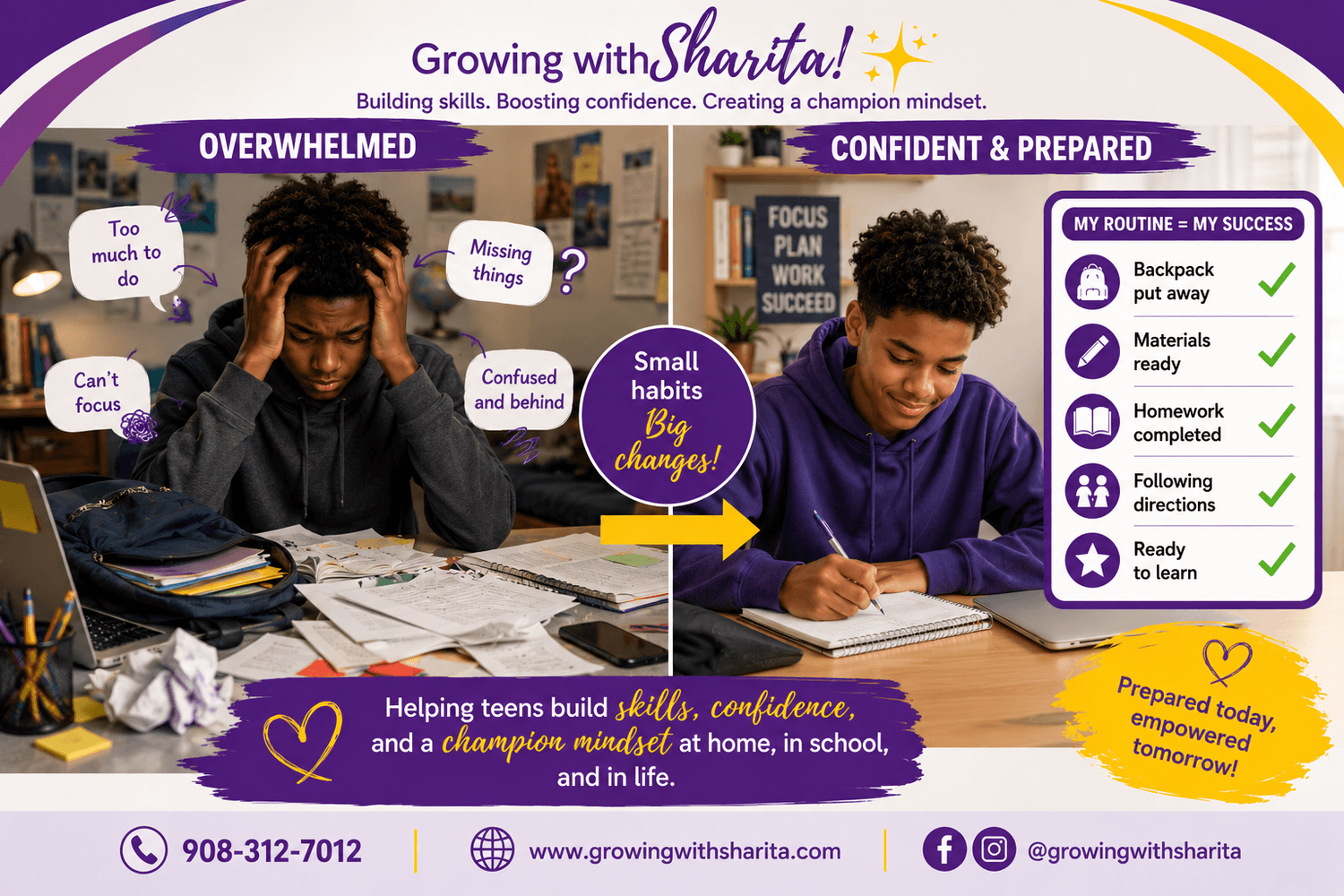
About Growing With Sharita
Is your child struggling with reading, math, focus, confidence, behavior, or school routines?
At Growing With Sharita, we help students build strong academic skills while developing the confidence, discipline, and growth mindset needed for long-term success.
📞 908-313-1973
🌐 www.growingwithsharita.com
✨ Ready to help your child thrive academically and emotionally?
Schedule a free consultation:
https://calendly.com/growthinstitute100/free-consultation
Because every child deserves the opportunity to discover just how much they are capable of achieving. 💙


Hey y'all! 🙌🏿
Hi, I'm Sharita Morgan!
With 20 years of experience as a mental health specialist, special education teacher, and mom, I've learned that there is a direct link between behavior challenges in the classroom and illiteracy.
That's why I combine behavior and literacy coaching to help kids make better choices, take responsibility, and improve academically.


JOIN MY MAILING LIST

The only coaching program for kids that offers you Behavior, Math, and Literacy coaching to get you real results in the classroom and in life! Also offering classroom management services.
+1 908-313-1973
Follow us

Newsletter
Subscribe now to get daily updates.